
We have been living through an increasing bombardment of imagery for more than a century—first amplified by mass media, then by digital tools, software and social platforms. But none of it compares with the volume we encounter today. Generative AI has accelerated that production again.
With the democratization of tools comes the democratization of production. And with more production comes more of everything. Yes! Including a lot of bad work.
Cheap ideation. Cheap result.
“AI slop” initially described the visibly crude, uncanny or lazy outputs of early generative models. Increasingly, however, the term is being applied indiscriminately to machine-generated content—not according to any consistent criteria of quality, but according to its method of production.
AI may democratize access to production, but access to production should not be confused with expertise in direction.
Hence: AI + made = slop
But to assign bad imagery to AI as though AI invented it is to disregard the enormous amount of bad work that existed long before generative AI became dinner-table conversation. See-Threepio, be the doll, pass the gravy, please!
Over the course of my career as an editorial Art Director, I encountered countless examples of visual slop in design, photography, illustration and writing. And none of it had anything to do with AI. So before we apply the term to anything and everything, I think we need to clarify what exactly we mean by it.
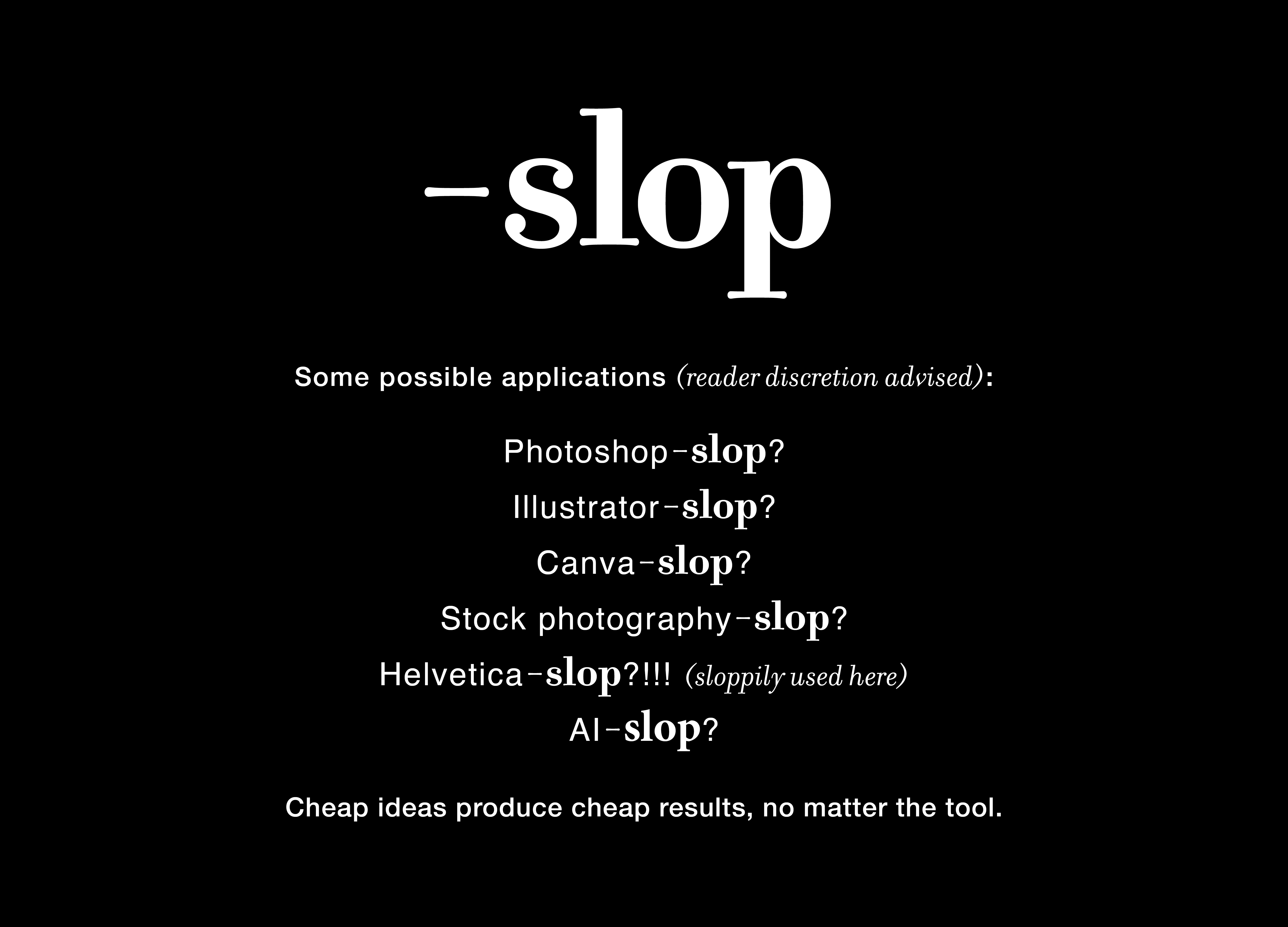
This is how I see “AI slop”—or, more precisely, “-slop.” Yes! The hyphen stays.
Photoshop-slop
Illustrator-slop
Digital photography-slop
Canva-slop
Selfie-slop
AI-slop
Whatever-slop
And long before any of those existed, many made perfectly good slop with scissors, Letraset and a photocopier.
What I call -slop isn’t defined by the specific technology, tool or process that produces it. AI may have an uncanny ability to augment the appearance of quality and accelerate the speed of production, but it didn’t create the underlying phenomenon. -Slop emerges from a discrepancy between the conceptual strength of the work and the appearance of quality: when weak thinking is carried by execution convincing enough to suggest greater conceptual value than is actually there.
Hence, strong authorship results from research and ideation, judgment, selection, and the deliberate exercise of one’s knowledge and experience.
The burden of “unsloppiness” lies with the creator—the one using the tool, exercising authorship and directing the process.
Slop predates AI
It’s interesting how quickly we forget the arrival of Photoshop and Illustrator almost 35 years ago. Suddenly, people without years of professional training could produce polished images and slick logos with immaculately clean lines, ready to print.
Everyone is so creative!
And I would push this further. Professionally, being a great illustrator does not necessarily mean knowing how to conceptualize the right visual response to a brand problem, just as being a brilliant photographer does not necessarily mean knowing what makes the right portrait for a particular cover or ad campaign. Expertise in a specific craft and the ability to direct a visual response are not the same thing. This is why I believe versatile creators, whose practice encompasses a broader range of disciplines and ways of thinking, are becoming increasingly important. Their expertise is not in being the best practitioner of every craft, but in understanding what the work needs, who or what can best produce it, and recognizing excellence when they see it.
The software dramatically lowered the threshold of execution. But lowering the threshold of execution did not automatically raise the quality of the ideas being executed.
Digital tools also accelerated another enormous production economy: stock imagery. Prefabricated photographs, illustrations, vectors and logo elements could be bought, modified and reconstructed into seemingly finished work.
You could now imitate the surface qualities of watercolour, oils, photography or illustration without learning the physical medium itself. That didn’t make the tools illegitimate. It simply separated technical access from the knowledge and judgment that had traditionally taken much longer to acquire.
I benefited from that democratization myself. I wasn’t trained as a photographer, but I learned to edit photography and construct complex photographic narratives. The tools expanded what I could make. And countless others did the same—with wildly different results. The evidence is that a lot of manual slop is now mistaken for AI-generated slop. The irony!
And before that?
Desktop publishing democratized publishing. Digital cameras removed film and processing barriers, contributing to the unprecedented volume of photography we now encounter online. Canva introduced us to pre-fabricated templates and thus dramatically lowered design-production barriers.
So yes, when it comes to scale, a slopper using AI can slop faster and more.
But comparison with earlier technologies is faulty at its core. We don’t possess an equivalent historical record of everything produced with Creative Suite software. Social media did not yet place billions of outputs into a single global feed where both quantity and quality could be observed at once.
AI may therefore be producing unprecedented quantities of slop. But unprecedented visibility and unprecedented production are not quite the same thing.
The appearance of quality is not quality
A weak idea fed into an AI model can produce, if only briefly, a visually appealing result—one that may appear sophisticated until the eye candy wears off and the concept-starved brain urgently starts searching for one.
Increasingly sophisticated technologies can also make weak work appear familiar and already culturally loaded.
But this phenomenon existed long before AI. We are continuously exposed to visual culture and accumulate its language and codes. Helvetica has been used successfully for decades. Don’t know what typeface to use for your next design and are crunched for time? Helvetica is at your service! We have seen certain photographic treatments, compositions, layouts, logos and cinematic conventions work again and again. Inevitably, consciously and/or subconsciously, what we make and what we respond to may become a byproduct of this cultural and social exposure:
A logo can resemble Apple.
A photograph can resemble a luxury campaign.
An illustration can resemble Pixar.
A video can resemble cinema.
But surface resemblance doesn’t necessarily carry deeper conceptual value, original thought, or intent, nor is it necessarily contextually appropriate.
Ideally—and rarely—we get the equilibrium: strong idea + strong execution = strong work.
More often, one is ahead of the other.
Strong idea + weaker execution: the idea is coming through, but the execution falls short.
Weak idea + strong execution: this is where we start moving closer to -slop. The output may be beautiful, polished, coherent, cinematic, technically spectacular. It looks nice. But so what?
And finally:
Weak idea + weak execution: one may think this is -slop. I think this is simply bad work, which, by the way, also has every right to exist.
-Slop occupies a territory of its own. It exists somewhere on the edge of brainless and looking great. And this is why we find it so repugnant—the contradictory experience of being pulled in by familiar visual cues, with nothing there to hold us.
But if the machine is a tool, is it the machine’s fault that the author brought a weak idea to it?
And what about the audience that gravitates toward it? And what about the audience that mistakes bad traditional work for AI work?
Just as AI may expose a weak creator, perhaps it also exposes our ability—or inability—to judge what we see. Social media rewards immediacy. Examples I see on LinkedIn often receive thousands of likes. But why?
What exactly are we liking?
The idea? The execution? The technical spectacle? The familiarity? The novelty? Or simply the immediate visual reward?
Surface value may survive for a moment. The work has to survive scrutiny. Great work survives repeated scrutiny.
The tool is the wrong unit of judgment
If the tool itself determines the quality of the work, then Photoshop should produce only excellent images. A Leica should take only excellent photographs. Illustrator should produce only excellent logos.
But none of this is true. And neither is it true of AI.
A tool can expand the possibilities of an output’s quality. But it cannot compensate for weak authorship or guarantee conceptual value. That remains dependent on what the author recognizes, develops, selects and ultimately makes of what emerges.
Authorship does not require total control over what happens. It requires agency over what becomes the work.
Certainly, there are legitimate concerns surrounding AI—its environmental impact, its effect on labour, questions of copyright, consent and attribution. But those are not necessarily the same questions as whether a particular output is good or bad.
Critique of the process and critique of the resulting work may overlap, but they are not interchangeable.
Something can be ethically questionable and aesthetically powerful.
Something can be ethically impeccable and aesthetically ugly.
Something can be hand-drawn and mediocre.
Something can be AI-assisted and conceptually evocative.
Knowing how something was made may change the criteria by which we judge it and the approach we take. But it cannot substitute for judging the work itself.
But this leaves a more difficult objection. AI, one may argue, is different.
“You cannot have authorship with AI,” someone recently told me.
Or can you?
If the tool doesn’t author quality, what does?
Working in editorial design, I watched the baton of authorship pass continuously from one creator to another, rarely remaining in one pair of hands for very long. A concept may originate with a Creative Director, move to an Art Director, then to a photographer or illustrator, encounter the agency of the subject, return to an editor, a writer, the Creative Director—and back again.
At every stage, someone exercises agency over the work. The concept is judged, directed, interpreted, edited, curated, critiqued and evaluated. Yet all those individual acts of authorship, guided by a shared vision and the mandate of the publication, eventually compress into a singular output—and perhaps a changing form of authorship.
A Creative Director may or may not take the photograph, and may or may not edit it. But neither does a conductor play every instrument in the orchestra. Physical execution and authorship were never synonymous.
AI compresses that process differently. Functions that were previously delegated to multiple practitioners across multiple stages can now be merged into another kind of creative process.
If authorship can exist within a nonlinear, distributed process, at what point does compressing that process eliminate it?
What if authorship resides not in performing every act of execution or participating at every stage of the process, but in exercising agency over the transformation of an idea into its final form, ultimately deciding what constitutes the work?
The execution may be distributed. Authorship is neither eliminated nor acquired on the basis of the chosen process. It is manifested in how the final work is shaped.
The more a tool is capable of doing, the more necessary judgment becomes. Without it, the capabilities of the tool begin to shape the work instead of the author shaping the capabilities of the tool.
And yet, AI has increasingly become an identity marker, reorganizing creative discourse into camps: Pro-AI. Anti-AI. AI artist. Non-AI creative. Real artist. Fake artist. And somewhere in that division, questions of origin begin to replace evaluation.
“AI made it” becomes a measuring stick in itself. But that tells us an extremely redacted version of the process—and almost nothing about the quality of the final work. Just because something is made by hand does not make it exceptional. Not yet, at least.
We may be entering an age of more images, more writing, more video and more creative production than human beings have ever encountered—all produced at staggering speed.
And in this ocean of -slop, the work that will stand out is that which successfully resolves concept and discovery into visual form through a method of production true to the work.
And what happens when the method is invisible? Put several conceptually strong, visually resolved works beside one another without identifying which were made traditionally, digitally or with AI. If we cannot reliably distinguish the method of production, on what basis do we determine which one is -slop?
The answer cannot be to outsource judgment to a label.
Look at the work. What’s the idea? What does it communicate? Why does it exist? Does it withstand inspection? And what tool and medium would most successfully mold the idea into form?
Then call it whatever you like. Including -slop.